
COMMERCIAL BUILDING ENERGY EFFICIENCY
NCC 2025 Preview Draft
The recently released NCC 2025 Volume One Preview Draft signals major Section J changes for commercial buildings, including explicit greenhouse gas limits and “near zero” operational emissions.
The NCC 2025 Volume One Preview Draft has just been released, and it contains material changes to energy efficiency requirements for commercial buildings.
At first glance, the changes in NCC 2025 for commercial buildings can look a bit like just ‘tightening the numbers’. But several of the changes are more fundamental – and will shift the conversation around energy efficiency for these buildings.
We’ll be reviewing the draft in detail over the months ahead. For now, this article will cover the headline shift and why it matters.
NCC 2025 Adoption Timing
It’s worth noting that NCC 2025 has not been adopted yet.
As at February 2026, Australian states and territories (who control adoption of the NCC) have not published an adoption schedule.
Adoption is likely to be some time away. Even once adopted, states typically allow an optional adoption period. Mandatory adoption could be 2027 or later… we just don’t know yet.
So no action required by you at the moment!
NCC 2025 Performance Requirement J1P1
The NCC Performance Requirements are the highest level compliance requirements of the National Construction Code – every DTS check, every J1V3 model, every report, every drawing note is just a method of showing a design satisfies the Performance Requirement.
When the Performance Requirement changes, the whole downstream compliance conversation changes with it. That’s the case with NCC 2025 for Commercial Buildings.
Energy Efficiency in the NCC (Section J) has four performance requirements – the most important of these for Commercial buildings is J1P1. This is what J1P1 says in NCC 2025:
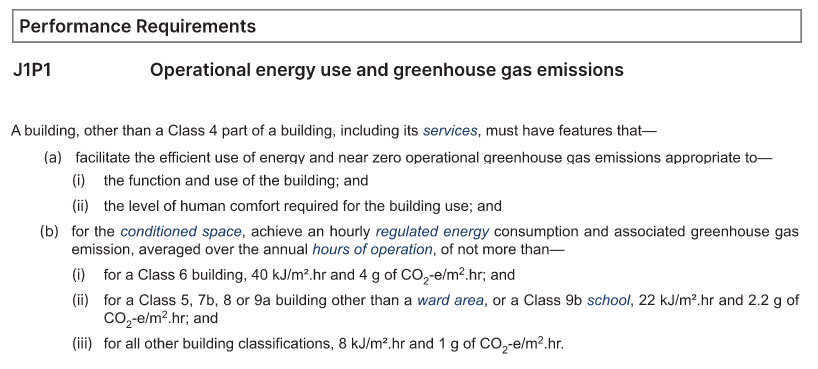
So what’s been changed from NCC 2022? There are at least two major changes here:
Change 1: Greenhouse gas emissions are now explicitly part of the requirement
Previously, NCC 2022 had a general consideration of “energy source” and “energy consumption”.
NCC 2025 is reframing that to require explicit consideration of energy consumption and associated greenhouse gas emissions.
While that sounds subtle, it isn’t.
It means the code is no longer satisfied with “efficient energy use” as a standalone idea. The carbon emissions of the energy source(s) now also matter.
Change 2: "near zero operational greenhouse gas emissions"
This is big! NCC 2025 introduces language requiring near zero operational greenhouse gas emissions for commercial buildings.
NCC 2025 will require most commercial buildings to achieve an energy consumption that is reduced by up to 50% of the current energy caps under NCC 2022. On top of that, an additional greenhouse gas emissions cap is introduced, expressed as g of CO2-e/m².hr. These are major alterations to energy consumption targets.
There are significant implications from this:
-
-
-
- building fabric and services targets get tighter
- energy source starts to matter more, because emissions are now part of the compliance conversation
-
-
For many commercial buildings, renewables will stop being a “nice sustainability add-on” and start being an essential part of the path to compliance.
What will change in commercial building design?
It’s early days, and we are still getting to know NCC 2025. But here’s our prediction of some of the likely effects of the shifts on how commercial buildings are designed.
1) Tighter Building Fabric & Services
This one is obvious – one or more of the glazing, insulation, building fabric in general, along with mechanical plant and services in a building will inevitably tighten under NCC 2025.
Under the DTS requirements, low e glazing (at least) will become mandatory. Wall, roof and floor insulation requirements will all step up. Mechanical plant and lighting design will also be impacted.
2) Earlier consideration of Energy Efficiency requirements
We are already seeing this in design, as projects involve EE consultants earlier, to reduce the impact and disruption that requirements can have when introduced later in the project. We expect there’ll also be a broadening of the EE consultation to include:
- façade direction and glazing intent
- services strategy
- controls philosophy
- roof planning (including what’s competing for space)
3) We'll be talking about solar panels a lot
We predict some friction on this one! Part of our homework over the months ahead is to work out what impact solar panels and other renewable energy sources will have on the design of commercial buildings. The reality is that inclusion of renewables in commercial building design will in most cases become mandatory – your commercial roof will in most cases have solar panels on it.
Key Takeaways
- NCC 2025 is not adopted yet, and adoption timing (at Feb 2026) is still unknown.
- The Preview Draft changes are material enough that it’s worth getting ready for them.
- The Performance Requirements are shifting to explicitly include operational greenhouse gas emissions.
- “Near zero operational greenhouse gas emissions” is a requirement that will flow through to tighter Section J outcomes.
- Most projects will find renewables (particularly, solar panels) become mandatory under the new provisions.
NCC 2025 FAQs
Wasn’t the NCC frozen until 2029? Why are there changes to commercial energy efficiency?
Energy efficiency requirements were frozen by the Australian Government until 2029, but that order applied only to residential energy efficiency. Commercial requirements are continuing on the usual 3 to 6 year update cycle.
Are solar panels required under NCC 2025?
Yes! Whilst the current NCC 2022 (the existing code) only requires electrical provision for solar panels (not the panels themselves), NCC 2025 will require solar panels for 100% of the roof all commercial buildings except where that’s not feasible (e.g. shaded roof, roof terrace etc.)
When will NCC 2025 be adopted?
While NCC 2025 is available for adoption from 1st May 2025, none of the states or territories have as yet published their adoption timetables. Some states use an optional/grace adoption period, so mandatory adoption could be 2027 or beyond… at this stage we’re still waiting for confirmation from the states and territories.
Prepare for NCC 2025
Get ready for the upcoming changes in commercial building standards. Stay updated with the latest NCC 2025 developments and ensure your projects meet the new requirements. Sign up for our newsletter to receive timely updates and expert insights.